Articles & Guides · Visas & Travel · Australia
Australia Training Visa 407 for Kenyans: Sponsor Guide
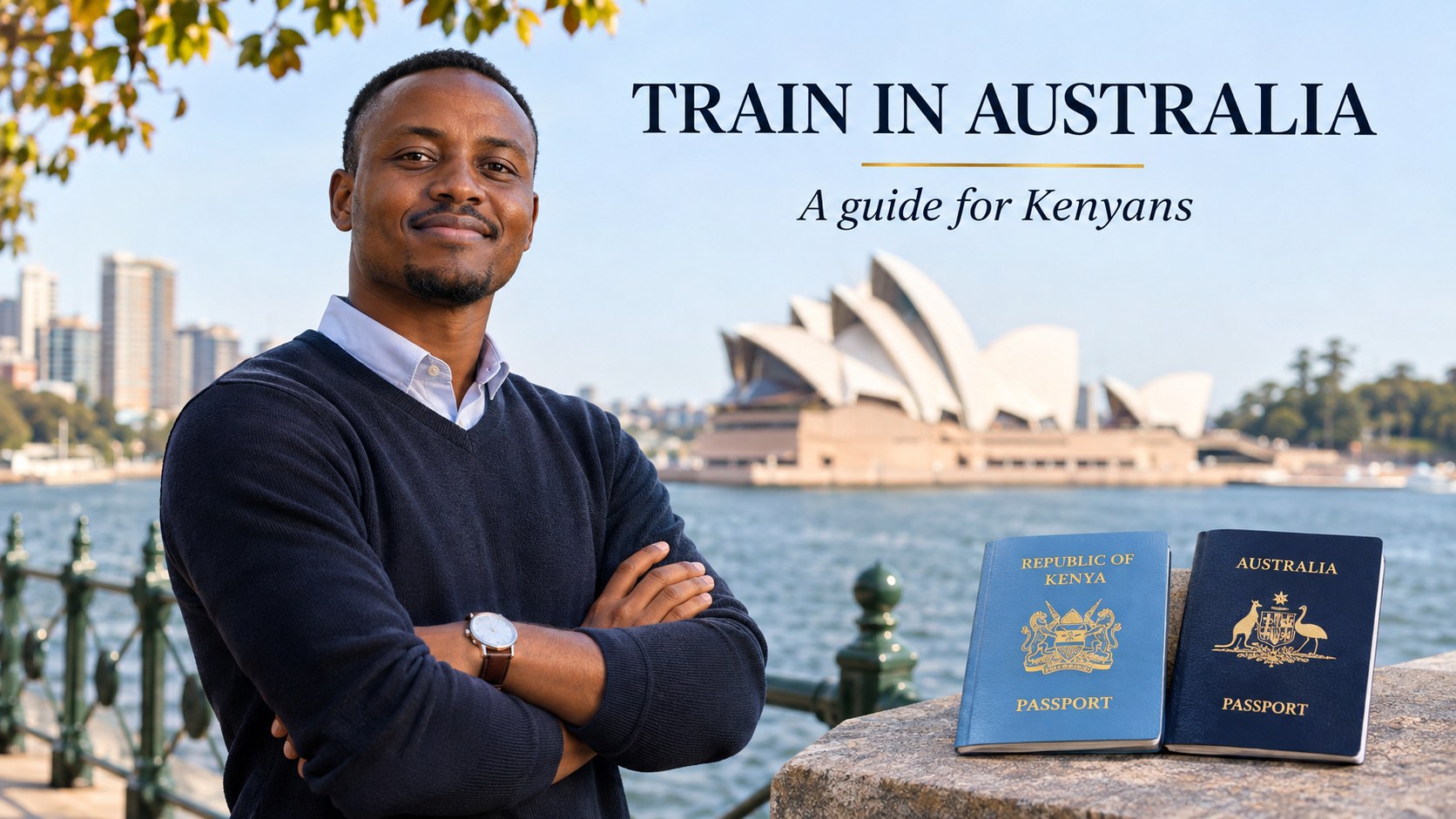
The Australia Training Visa 407 allows eligible Kenyans to undertake approved workplace training or professional development in Australia. This guide explains how to research sponsors, prepare your documents and plan your costs before applying.
Australia’s Training visa (subclass 407) permits approved occupational training or professional development for up to two years. It requires an approved sponsor and, except for Commonwealth agency sponsorship, an approved nomination before you apply. It is a temporary training route, with no automatic promise of permanent residence.
Application update: From 12 November 2026, you must be outside Australia when you apply and when the visa is granted. Earlier valid applications remain subject to the rules applicable when lodged. Read the official application-rule notice.
In this guide
- Australia Training Visa 407: is it right for you?
- How to find a training sponsor
- English requirements for Kenyans
- Documents to prepare
- Costs and your budget
- Do you need an agent or recruiter?
- Your next step from Kenya
- How Luvisia Digital can help
Australia Training Visa 407: is it right for you?
Start with a specific question: What skill do I want to learn, and how will I use it? “I want to go to Australia” gives a potential host little to assess. “I have experience in plant tissue culture and want supervised training in commercial propagation techniques” gives an organisation a clearer starting point.
The visa covers training for registration, skills improvement in an eligible occupation, and overseas capacity building. Each has different requirements. Review the official training categories with the proposed host.
Before committing, check your background, English evidence, finances, insurance, health and character requirements against the Home Affairs visa checklist. A qualification alone does not establish eligibility.
How to find a training sponsor
Treat sponsor research as a focused professional search. The aim is to identify an organisation whose work matches your experience and which is willing and able to develop an appropriate training arrangement. The following are practical research steps, rather than confirmed vacancies or sponsorship offers.
1. Define the training you want
Write down your qualification, relevant experience, two or three skills you want to develop, and your preferred training period. Be precise enough for a host to identify the team or supervisor who could assess your enquiry. For example, a biotechnology graduate might focus on seed testing, greenhouse trials or laboratory quality procedures, rather than request any available position.
2. Research organisations that match your field
Build a shortlist from Australian employers, research institutes, universities, hospitals or professional training organisations relevant to your background. Check their own websites for current projects, training programmes, careers pages and contact details. These are places to investigate; their inclusion in your search does not mean they offer subclass 407 sponsorship.
Try searches such as “subclass 407 training” + your occupation, “occupational trainee” + your field + Australia, or “professional development placement” + your specialisation. Follow each useful result back to the organisation’s official website. A social media advert should be a lead to verify, rather than the basis for payment.
3. Send a short, relevant enquiry
Contact the organisation’s training, human resources or relevant departmental team. Attach a focused CV and briefly explain your background, training goal and why you chose that organisation. Avoid sending passport scans or bank statements with an initial unsolicited enquiry.
Your opening could be: “I am a Kenyan professional with qualifications in [field] and experience in [area]. I am seeking supervised training in [specific skills]. Does your organisation consider overseas trainees under the Australian Training visa subclass 407, and could your team assess a possible placement?”
Personalise each message. A reference to the organisation’s actual work makes it easier to see why you are approaching it. Keep a simple record of the organisation, contact person, date sent and response, so you can follow up without duplicating enquiries.
4. Verify sponsorship and the proposed placement
Ask the host to explain its sponsorship position and how it would arrange the training nomination. Request written details of the supervisor, learning objectives, location, duration, pay, fees and accommodation. Confirm the organisation and contact person through independently obtained official details.
Do not assume that an ordinary job advert, an internship offer or sponsorship under another visa establishes a suitable 407 placement. If a recruiter introduces you, ask for the host’s name and verify the claimed relationship directly before paying.
English requirements for Kenyans
Kenyans must provide acceptable evidence of functional English; a Kenyan passport alone does not qualify for the passport-based evidence route. An English test is not necessarily the only option. Home Affairs also accepts specified English-medium education, including a qualifying degree, diploma or trade certificate involving at least two years of full-time study or training entirely in English.
For a Kenyan applicant, the useful first step is to check whether your education meets a listed pathway and obtain suitable evidence from your institution. Do not assume that studying in Kenya automatically satisfies it. Compare your documents with the official functional English requirements before paying for a test.
Documents to prepare
Create a working folder for your passport, CV, academic certificates, experience letters, English evidence and any relevant professional registration. Once a host is confirmed, use the official checklist to add sponsorship and nomination documents, financial evidence, insurance and other requested records. Requirements depend on your circumstances; an initial folder is not a complete application checklist.
Costs and your budget
Separate the government visa charge from medical checks, document preparation, insurance, flights, accommodation and day-to-day living costs. Check the current charge on the official visa page before payment. Convert Australian-dollar costs into Kenyan shillings using the exchange rate available when you budget, and allow for bank charges.
Ask the host exactly what it will pay and what you must cover yourself. Sponsorship does not necessarily mean free flights or housing. Home Affairs states that work undertaken under this route must be paid. Get the proposed terms in writing; do not build your budget around an unconfirmed allowance.
Do you need an agent or recruiter?
You can research hosts and contact them directly. A recruiter may help locate an opportunity, but an introduction does not guarantee sponsorship or a visa. If you need personalised immigration advice, check the adviser’s authority and registration through official channels.
Be cautious of guaranteed approvals, unnamed hosts, pressure to pay immediately or requests to fabricate experience and financial documents. Ask for a written description of every paid service, its fee and refund terms. Keep copies of receipts and correspondence.
Your next step from Kenya
Begin with your CV and a clear training objective. Build a shortlist, make targeted enquiries and evaluate the responses before committing to travel costs. Use the official subclass 407 page as your reference throughout; processing times vary, so avoid booking travel around an assumed approval date.
How Luvisia Digital can help
If you need help getting started, email info@luvisiadigital.co.ke with your field of study, relevant experience and the skills you want to develop. Luvisia Digital can help organise your CV and documents, research potential host organisations and prepare professional outreach enquiries. We will explain the proposed service and charges before you proceed.
Luvisia Digital does not issue visas or guarantee a placement. The Australian organisation must confirm its participation and sponsorship arrangements; Australian authorities decide the visa application. Personalised immigration advice should come from an appropriately authorised professional.
Reviewed on 7 November 2026. This guide is for Kenyan readers and provides general information. Check the linked official requirements before applying or paying.